Music from Tuning the Air, Volume 2
Season 4 Closing Night - Capitol Hill Arts Center - December 17, 2007
(All proceeds from sales of the “Music from Tuning the Air” series go to Seattle Circle, a 501(c)(3) not-for-profit organization, and are tax-deductible. Seattle Circle’s mission is “to develop and promote appreciation in music in the Puget Sound area through education, workshops and music events.” Tuning the Air was a big one! Their work continues, and your support is greatly appreciated.)
In the third year of Tuning the Air we began to consider the possibility of moving out of our cozy little home in Ballard, and into a larger and higher profile venue. A deal was struck with Capitol Hill Arts Center for a 10-week run, beginning in October and running up to the Christmas break.
Over the summer break we worked on designing and building the staging for a presentation far more ambitious than anything we’d worked with before. The fundamentals needed to be honored – we perform in a Circle with the audience inside – but this was a step up in terms of visibility. Lights and risers. Travis Metcalf’s vision of translucent fabric “Columns of Awesomeness” hanging behind each player, reflecting Meleah Gibson’s lighting scheme.
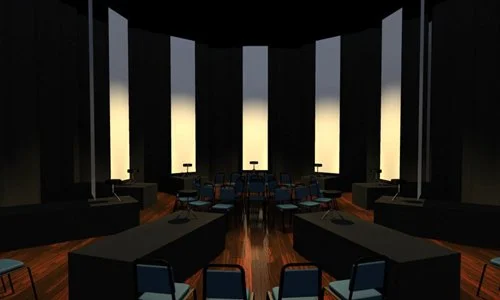
(Travis Metcalf’s rendering of the set design)
And, for the first time, we needed to be amplified. This was probably the trickiest problem to solve. What we wanted was very light “sound reinforcement” rather than a traditional full-out PA system. If we did it right, the audience would not be aware of the amplification, but simply be able to hear more clearly regardless of their location in the space.
For the first five weeks of that Fall Season we continued to perform at Trinity, using that time to put together a very tight set, and then on October 15 we moved to CHAC.
Setlist:
Entrance - Twinkles and Zither in C Melodic Minor (SGC/Solaris Project)
Tuning The Air (SGC)
Onyx (Abuladze)
My Precious Dream (Binder)
Batrachomyomachy (Geballe)
Magic Chord Zither (SGC)
Where Is The Nurse? (Geballe)
Eleanor Rigby (Lennon/McCartney, arranged: Gibson)
Sigh and a Kiss (Williams)
Circulation in C Minor (SGC)
Voices of Ancient Children (Nunez/Kabusacki)
The Wig Maker (Gibson/Metcalf)
The Bus Artist (Abuladze/Metcalf)
Kashmir/Led Zeppelin Mashup (Page/Plant/Bonham/Jones, arranged: Abuladze/Metcalf)
Ikada-Jima (Gibson)
King for a Day (Jensen)
Music for a Found Harmonium (Jeppes)
Applause
Acknowledgements and Introductions
Horn Up Your Ass (Guitar Craft Traditional)
Address the Audience
Not My Sharona (Geballe)
49 Notes (Golden)
Guitarists in the Circle, in seating order:
Howard Snyder (in absentia)
Igor Abuladze
Andrew Boscardin
Bob Williams
Curt Golden
Travis Metcalf
Chris Gibson
Taylor Sherman
Jaxie Binder
Preshow Music: Solaris Project (Igor Abuladze and Travis Metcalf)
Sound Reinforcement and Recording: Andy Boyd
Stage Lighting: Meleah Gibson
2026 Mastering: Steve Turnidge
Season 4 Support Team: Christina Florkowski (Publicist). Ian Bessler, Mary Beth Abel, Igor Bekker, Dhyana Garcia (House Team)
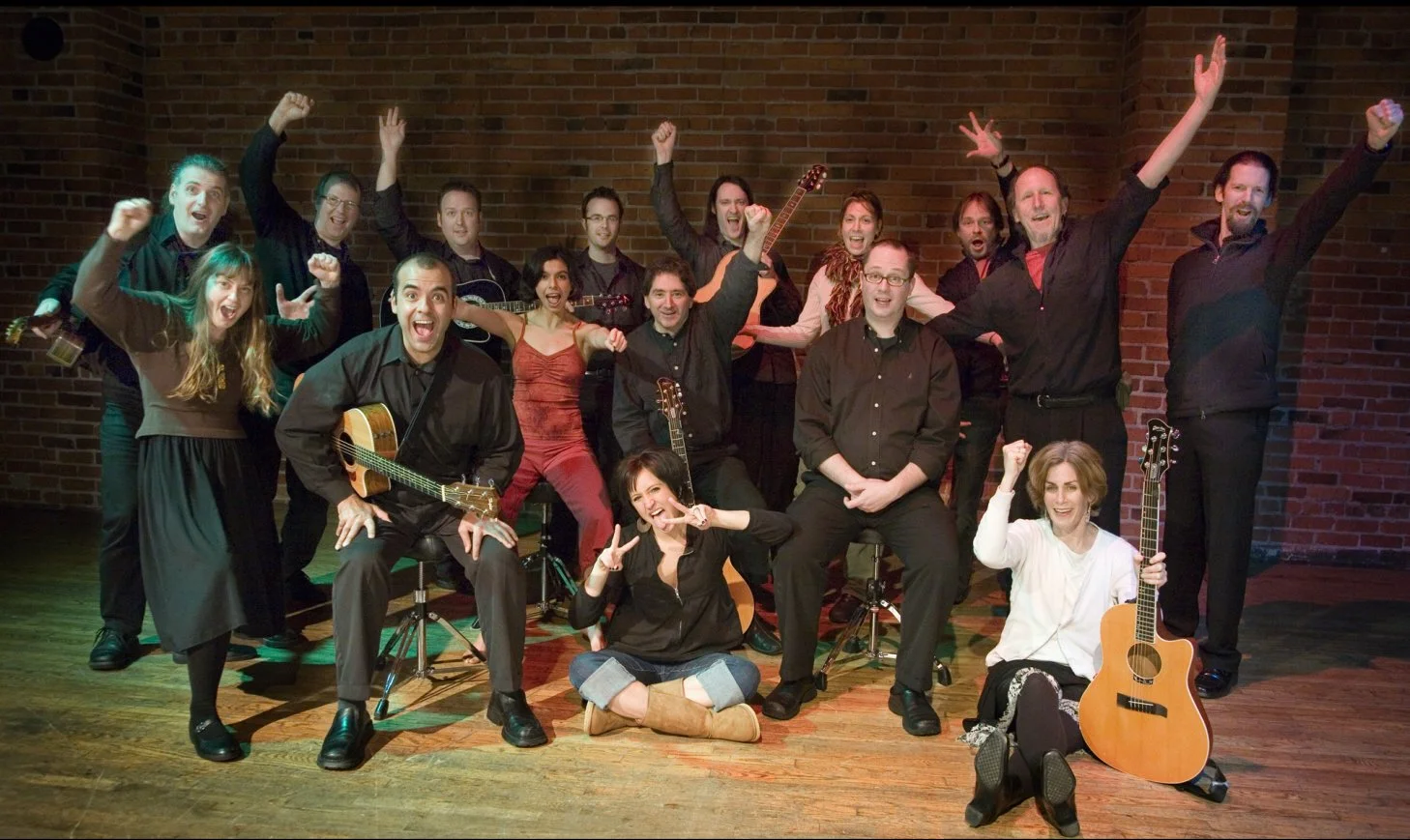
(Photo Animation by Christina Florkowski)
Notes from the Archivist
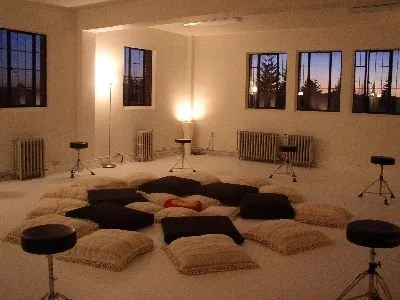
For the first two and a half years (105 performances), Tuning the Air was presented in Seattle Circle’s performance space/headquarters, located on the third floor of Trinity United Methodist Church in Ballard. We could accommodate an audience of up to about 25, seated on cushions on the floor inside the circle. The room was nicely resonant, and all performances were acoustic.
With the move to larger venues it became necessary to utilize sound reinforcement. The approach we adopted was to keep this as minimal as possible, retaining the 360º acoustic experience while filling out the sound. This made the music more clearly audible for larger audiences, especially when they were larger than the inside of the circle could accommodate. And by the end of the CHAC run that was every week.
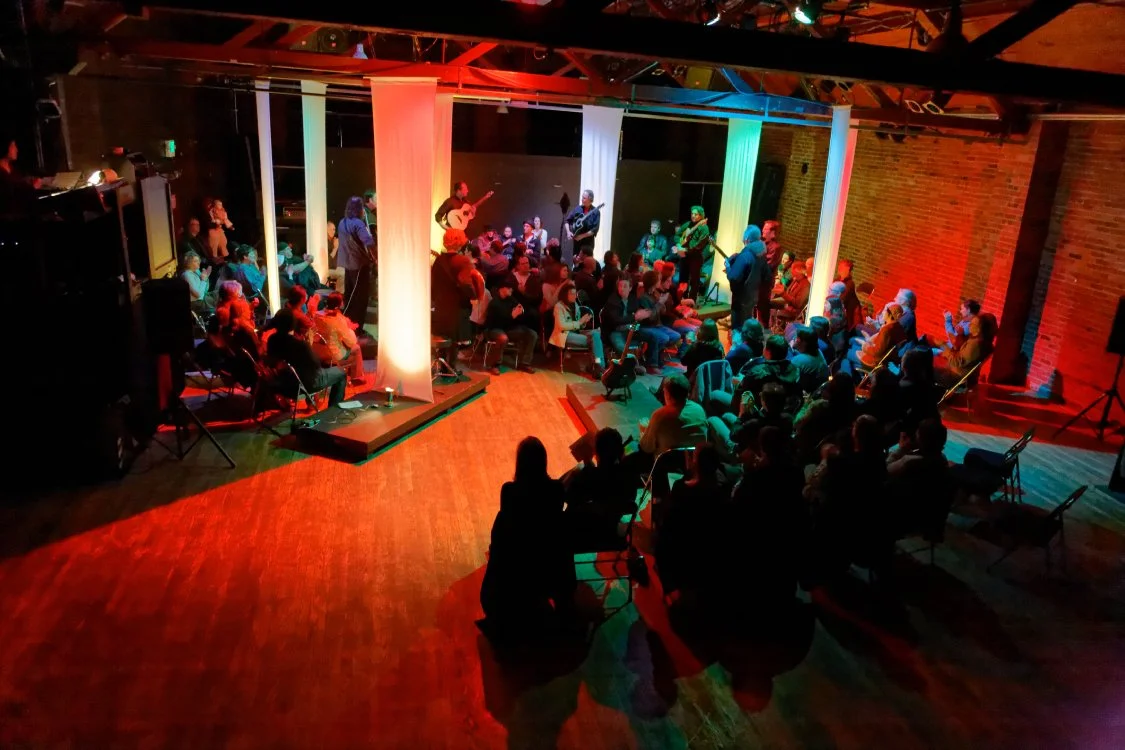
(Photo by Christina Florkowski)
For recording live performances of Tuning the Air, Andy Boyd used a binaural microphone set-up; a pair if isolated microphones on a tall stand in the center of the audience. This captured a very natural stereo experience which is particularly evident when listening to the recordings with headphones. His aim was to recreate in the recordings the aural experience of the audience, as closely as possible.
He continued using this method even after sound reinforcement was introduced. All of the recordings are live in the room, rather than taking feeds out of the mixer. So even though electricity is involved, we hear what the audience was hearing.
The performance captured in this recording took place about 6 months after the recording issued as Volume 1. It is the same performance team, although we were one player down due to some holiday travel.
In 2007 we had begun breaking the year up into two discrete seasons. This gave us two breaks; one in the summer and the other around New Years. In addition to giving the company members time for much-needed rest and rejuvenation, it also allowed us to write, arrange, and rehearse new material in order to keep the show fresh and always moving forward. About half of this performance was either brand new or had been reactivated from our rather sizable stockpile of available repertoire.
Tuning the Air performance teams were always well-rehearsed and tight, and settled for nothing short of excellence. Volume 1, which was recorded in our performance space without an audience, demonstrated this nicely. For this performance, however, there was an audience. Anyone who has ever performed knows that this changes everything. The presence of an audience moves us into a new realm. This is very clearly live, and there is life and vitality in the music that can be heard and felt.
In addition to the audience, what is particularly notable for me about this performance is the presence of Silence. In preparing this recording for release, I did no editing other than a fade-in of the audience just before our entrance and a fade-out of the applause as we make our final exit. Nothing was removed. This is the show from beginning to end, as it unfolded. There is an audience of about 150, but other than a little ordinary rustling and the occasional cooing and babbling from a baby, They listen in complete Silence for the entire performance.
After the final note of the final piece of our final performance of 2007 is sounded, there are 20 seconds of the most delicious Silence before the baby gives the audience permission to break into applause.
Curt Golden, September 2026, Seattle WA